Mastering UX Copywriting: The Ultimate Guide to Conversions and Clarity
UX copywriting creates great digital experiences, but rarely shouts. They guide quietly, like a well-lit path that helps users move forward without stopping to ask for directions.
That quiet guidance is its work, often invisible when done right, painfully obvious when done wrong.
When UX copywriting is clear and intentional, users feel confident and reassured as they navigate interfaces.
When it isn’t, even the most beautiful design can cause uncertainty.
Buttons confuse.
Instructions slow people down.
Friction builds, patience thins, and users drop off before reaching their goal.
Unclear microcopy comes at a real cost. Confusing labels, vague error messages, and jargon-heavy instructions increase hesitation, raise cognitive load, and chip away at trust.
Over time, these small moments of friction quietly erode usability, engagement, and conversions.
In this article, you’ll learn how UX copywriting puts users first, how it improves clarity, builds trust, reduces friction, and supports better decision-making across digital experiences.
By the end, you’ll see how thoughtful it turns interfaces into conversations users actually want to finish.
Human-First UX Copywriting
Great UX copywriting goes far beyond choosing words for buttons.
At its essence, it helps users understand what to do, anticipates their needs, reassures them at the right moments, and guides them forward with confidence throughout a digital experience.
Read more: Conversion Copywriting: How to Turn Traffic Into Paying Customers
Strong UX copywriting lives at the intersection of design, psychology, and content strategy.
Rather than showing off clever language, it focuses on the user’s context, what they’re trying to accomplish, what might confuse them, and what will help them move forward with ease.
The user’s needs always come before stylistic flair.
Defining Modern UX Copywriting
UX copywriting isn’t about filling empty text fields.
It includes every word users encounter inside a product interface, onboarding screens, tooltips, navigation labels, button text, error messages, and system feedback.
Its goal is simple but powerful: help users complete tasks smoothly by making intentions and actions unmistakably clear.
Unlike traditional marketing copy, UX copywriting prioritizes usability over persuasion. It supports the user’s journey rather than pushing for conversion at every step.
Seen this way, it becomes a design element rather than an afterthought. When words are treated as part of the interface, interactions feel cohesive, predictable, and far less confusing.
Simple Words, Seamless Flows
Clarity is the heartbeat of effective UX copywriting.
Users should never have to stop and decode a message’s meaning. The moment they hesitate, UX copywriting has missed its mark.
Simple, direct language keeps users moving. Clear instructions like “Please log in to continue” outperform jargon-heavy alternatives such as “Authenticate to commence session.”
The difference isn’t subtle; it’s the difference between progress and pause.
Read more: Unlock High-Impact Copywriting That Converts
In fast-paced digital environments, attention spans are short and mental bandwidth is limited. UX copywriting that favors plain language reduces cognitive load and helps users stay focused on their task rather than deciphering the interface.
Empathy in the Interface
Great UX copywriting begins with empathy.
Understanding who users are, and why they’re interacting with an interface in that moment, shapes every word choice.
Context-aware UX copywriting anticipates questions before users ask them. Instead of stating problems bluntly, effective error messages explain what went wrong and offer a clear next step.
This reduces frustration and prevents unnecessary backtracking.
Skilled UX copywriters think in terms of goals, not just words. They consider emotional states, offering reassurance after failure, clarity after completion, and guidance when uncertainty creeps in.
Because it sits directly in the user’s flow of action, empathy isn’t optional; it’s essential.
Say It Once, Say It Everywhere
Consistency is one of the quiet strengths of UX copywriting.
When terminology stays uniform across a product, users stop second-guessing and start trusting the interface.
Calling a section “Settings” in one place and “Preferences” in another may seem minor, but these inconsistencies force users to pause and recalibrate.
Consistent UX copywriting reduces this mental friction and strengthens comprehension.
Read more: Ad Copy Tips: 15 Secrets to Skyrocket Your PPC Conversions
Consistency also applies to tone and voice. When microcopy, from buttons to alerts, sounds like it comes from the same place, interfaces feel familiar and reliable.
Over time, this cohesion builds confidence and supports smoother UX flows.
Words That Include, Not Exclude
UX copywriting should work for everyone, not just the average user.
Its inclusivity and accessibility ensure that people with diverse abilities, needs, and contexts can navigate interfaces without barriers.
Its accessibility should make everyone feel included, not just the average user.
Using plain language and clear instructions helps users with diverse abilities feel respected and confident as they navigate interfaces without barriers.
It follows established guidelines: readable text alternatives, scannable structure, and predictable language patterns.
Accessibility isn’t a bonus feature; it’s a core requirement of truly user-first UX copywriting.
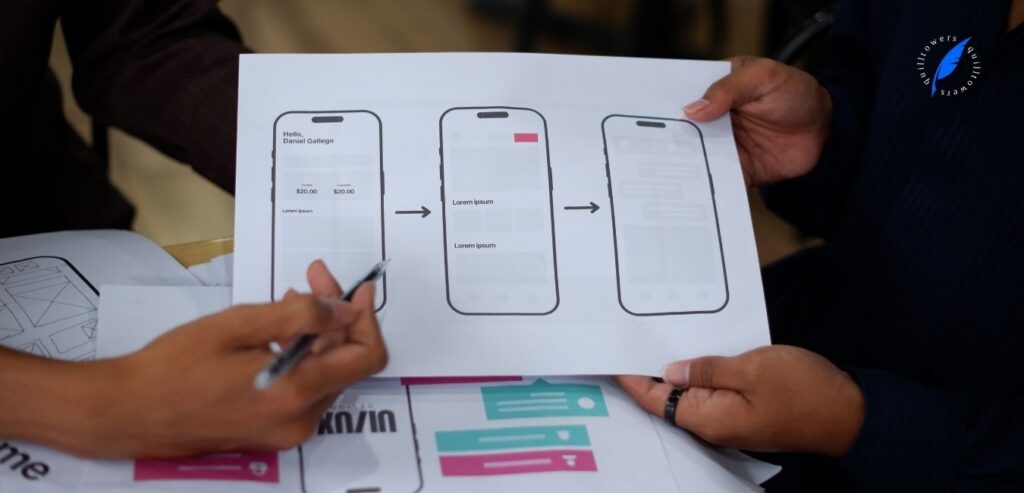
Mastering UX Copywriting for Digital Flows
Effective UX copywriting is where language and design move in lockstep, guiding users to understand, act, and succeed without friction across various digital platforms.
In digital products, this collaboration shows up most clearly in interface text and microcopy, buttons, error messages, onboarding cues, and form interactions that quietly shape how users move through a product.
Adapting copy for different platforms ensures consistency and clarity, enhancing overall user experience.
These elements may be small, but well-crafted UX copywriting punches far above its weight.
Strategic microcopy improves usability, reduces hesitation, and often drives measurable gains in engagement and conversions by removing uncertainty at critical moments in the user journey.
Measuring these outcomes helps you evaluate and refine your copywriting strategies for better results.
The End of “Click Here”
Buttons and calls to action are some of the most influential touchpoints in UX copywriting.
Generic labels like “Submit” or “Click here” force users to guess what will happen next. Clear, action-driven language does the opposite; it reassures users by making outcomes predictable.
Read more: Master SEO Copywriting: Power Up Your Brand Growth
Its effectiveness for buttons clearly states the action and result, such as “Download Report,” “Create Account,” or “Start Free Trial.” This clarity reduces hesitation and helps users move forward with confidence.
Strong button labels should:
- Use clear verbs that describe the precise outcome.
- Match user expectations rather than internal system language.
- Stay consistent across similar actions throughout the product.
Task-oriented labels like “Add to cart” or “Save changes” are far more helpful than vague alternatives.
In UX copywriting, specificity is what turns intention into action.
Turn “Dead Ends” into Directions
UX copywriting matters most when something goes wrong, because that’s when users are most likely to abandon a task.
Thoughtful error messages and system feedback transform frustration into understanding by explaining what happened and how to fix it.
A generic alert like “Invalid input” leaves users stuck.
Clear guidance, such as “Email must include an @ symbol”, removes guesswork and points directly to the solution.
This is it doing real work inside the flow.
The same principle applies to empty states. Instead of silent screens or flat messages like “No items found,” helpful copy provides context and direction.
Messages such as “You haven’t added any tasks yet, tap + to start” reassure users and invite action rather than confusion.
Error and empty-state microcopy should feel supportive, not punitive. In user-first UX copywriting, these moments are opportunities to help users recover and continue.
Start the Journey, Don’t Block the Path
Forms and onboarding flows are where many users hesitate or leave entirely.
UX copywriting reduces abandonment by clarifying expectations before mistakes happen and offering reassurance along the way.
Read more: Copywriting Services: 13 Winning Tips to Sharpen and Elevate Your Brand Story
Clear field labels paired with helpful microcopy eliminate uncertainty. For example, “Email address” combined with “We’ll only use this to send your receipt” builds trust while answering an unspoken question.
UX copywriting best practices for forms include:
- Using descriptive labels instead of placeholders alone.
- Adding concise helper text that explains requirements.
- Providing real-time guidance before errors occur.
- Keeping instructions short, clear, and skimmable.
In onboarding, it gently guides users forward without interrupting momentum.
Simple cues like “Tap the + icon to add your first item” act as quiet signposts, helping users feel oriented rather than overwhelmed.
The Friction Killer
Friction appears whenever users have to stop and think about what to do next.
UX copywriting reduces this friction by anticipating decision points and making the next step obvious, often with just a few well-chosen words.
This includes:
- CTAs that explain both the action and its benefit.
- Inline hints that prevent form errors before they happen,
- Progress indicators with reassuring, human language.
- System feedback that explains outcomes and next steps.
By aligning microcopy with user goals rather than internal logic, it reduces cognitive load and creates smoother, more intuitive flows across the interface.
Words as a System Requirement
UX copywriting should never live in isolation.
High-performing teams treat copy as part of the design system, documenting default language, variants, and accessibility rules alongside visual and interaction standards.
True alignment means:
- Involving UX writers early in design discussions.
- Using user research to shape tone, clarity, and context.
- Testing copy through usability or A/B experiments.
- Iterating based on real behavior, not assumptions.
When teams analyze where users hesitate or drop off, especially in forms or critical flows, it often reveals quick, high-impact fixes.
Refining just a few words can lead to meaningful improvements in task completion, satisfaction, and overall experience.

UX Copywriting: A Catalyst for Usability
Great UX copywriting isn’t just about sounding friendly; it’s a measurable force that can accelerate task completion, reduce cognitive load, and drive meaningful conversions across digital products.
When words are crafted with purpose, informed by user behavior, and rigorously tested, they help people understand what to do next, eliminate hesitation, and guide actions that align with both user goals and business outcomes.
Deleting User Hesitation
Every word matters in motion.
Users abandon tasks not because they don’t want to complete them, but because unclear instructions make them pause, second-guess, or quit.
Clear, concise UX copywriting acts as a silent guide, providing just-in-time meaning so users can move confidently through forms, workflows, and interactive flows.
Read more: Copywriting Services: 13 Winning Tips to Sharpen and Elevate Your Brand Story
For example, using action-oriented microcopy like “Create Account” instead of vague terms like “Proceed” instantly reduces friction and keeps users moving forward.
Faster task completion isn’t just anecdotal; it’s measurable. By clarifying expectations and actions, UX copywriting increases success rates and streamlines the user journey.
Simple Words, Lighter Minds
Cognitive load, the mental effort needed to understand content, can make or break a digital experience.
Overly complex language, jargon, or poorly structured content can strain users, leading to errors and drop-offs.
UX copywriting mitigates this by using plain, scannable language and a clear visual hierarchy.
Plain language strategies include:
- Everyday vocabulary over technical jargon.
- Short, digestible sentences.
- Step-by-step guidance for complex actions.
A well-organized interface, with bold headings, grouped content, and concise instructions, helps users process information quickly.
This approach reduces mistakes, builds confidence, and makes experiences feel intuitive rather than taxing.
The Science of “Continue” vs. “Proceed”
Even seemingly minor wording choices can influence outcomes.
UX copywriting must be continuously tested and iterated based on real user behavior. What seems clear on a design spec may confuse users in practice, which is why data-driven refinement is essential.
Read more: Website Copywriting Secrets That Drive Massive Engagement
Common UX copywriting testing methods:
- A/B testing CTAs, labels, and instructions.
- Usability tests to observe hesitation or errors.
- Heatmaps and analytics to track drop-offs or skipped content.
By comparing variations, teams can pinpoint which phrasing improves engagement, completion rates, and user satisfaction.
For instance, subtle differences like “Continue to Payment” versus “Continue” can significantly reduce user hesitation.
Moving the Needle with Words
Measuring the impact of UX copywriting requires tracking the right metrics:
- Task completion rate – percentage of users successfully finishing a given action.
- Error rate – frequency of mistakes caused by unclear instructions.
- Time on task – shorter times indicate clearer guidance.
- A/B test results – which copy performs better?
- Customer support tickets – frequency of microcopy-related inquiries.
Improvements in these areas often correlate directly with higher conversions. When users know exactly what to do next, they’re more likely to complete high-value actions, increasing both engagement and revenue.
Designing for the Bottom Line
The best UX copywriting stops being an aesthetic choice and becomes a strategic growth lever.
Clear, intentional language builds trust, reduces churn, and encourages deeper engagement. Case studies show that optimizing microcopy across onboarding and CTAs can boost conversions by 10% to 400%, depending on context.
Read more: Landing Page Copywriting Secrets for Creating Persuasive Pages That Convert
Integrating it early in design sprints and research cycles compounds value: fewer support tickets, higher satisfaction scores, and more users completing critical actions.
Words, when treated as a system-level design element, become invisible hands guiding users smoothly to their goals.

The Power of Words in UX
UX copywriting quietly guides users, turning confusing screens into simple, trustworthy experiences.
Its impact isn’t flashy; it’s functional, measurable, and essential.
When properly done, it transforms interfaces from confusing roadblocks into intuitive guides that move users effortlessly toward their goals.
Read more: Email Copywriting: Why These Simple Strategies Instantly Boost Open Rates
Final Takeaway
Good UX copywriting doesn’t shout, it guides, reassures, and accelerates action, making digital experiences seamless, efficient, and human-first.
Turn Every Interaction into a Win
With Quilltowers on your side, your UX copywriting becomes a growth engine.
Start optimizing experiences now and see users complete tasks faster and happier
Contact Quilltowers now before your competitors do.