AI Scriptwriting: How to Create High-Converting Scripts Faster in 2026
AI scriptwriting is the quiet storm reshaping content creation, and if your scripts aren’t converting, it’s not because your ideas are weak. It’s because they’re getting lost in the noise.
Think of it like this: you can have a brilliant story, but if it enters the stage without a spotlight, it fades into the background. That’s exactly what happens to most scripts today.
They start strong, but somewhere between the first line and the final call to action, the spark fizzles out.
In a world where attention spans flicker like candlelight, great ideas alone are no longer enough. AI scriptwriting offers precision, speed, and structure, transforming your ideas into compelling, high-converting scripts.
It doesn’t just help you write faster; it helps you write smarter. It turns scattered thoughts into a clear narrative, transforms hesitation into momentum, and bridges the gap between creativity and conversion.
In this article, you’ll discover how AI scriptwriting works, why it’s redefining content creation in 2026, and how you can use it to craft scripts that don’t just speak, but persuade, engage, and convert.
Because in today’s content landscape, the difference between being seen and being remembered often comes down to one thing: how well your story is told, and how quickly you can bring it to life.
Now it’s time to put your words to work.
The 2026 Paradigm: How AI Scriptwriting Redefines Creative Velocity
Content creation in 2026 is no longer a slow climb; it’s a fast-moving current.
What once took hours now takes minutes, and at the heart of this shift is AI scriptwriting. This isn’t just a trend. It’s a transformation.
Read more: Screenwriting Collaboration Mastery: Dos & Don’ts for Co-Writing Success
As demand for content grows across platforms, YouTube, TikTok, ads, and beyond, creators and brands are under pressure to produce faster without sacrificing quality.
AI scriptwriting answers that call, turning what used to be a scattered process into a streamlined system.
Instead of juggling ideas, outlines, drafts, and edits like spinning plates, creators now work within a single, connected flow. And in that flow, speed doesn’t come at the expense of quality; it fuels it.
Creative Computation: What AI Scriptwriting Really Means (Beyond Automation)
At a glance, AI scriptwriting may look like simple automation: type a prompt, get a script.
But beneath that surface is something far more powerful.
Modern tools powered by AI scriptwriting don’t just generate text; they assist with:
- Idea development.
- Story structure.
- Tone refinement.
- Audience alignment.
In essence, it blends creativity with computation. It removes the friction of starting from scratch and replaces it with momentum.
Instead of staring at a blank page, you’re stepping onto a moving train, already in motion, already heading somewhere meaningful.
Read more: Spec Script Success: Powerful Tips to Write One and Stand Out
AI-powered content tools are increasingly used to brainstorm ideas, create outlines, and draft content efficiently: And that shift matters, because the faster you move from idea to execution, the more opportunities you can capture before they pass you by.

The Shift from Manual Writing to AI-Assisted Workflows
Not long ago, scriptwriting followed a rigid path: research, outline, draft, edit, optimize.
Today, that process is collapsing into one fluid system.
With AI scriptwriting, creators can:
- Move from idea to draft in minutes.
- Edit and refine in real time.
- Optimize content as they create.
This shift isn’t just about speed; it’s about the evolution of workflow.
Instead of stopping and starting at every stage, AI scriptwriting creates continuity. It connects the dots between thinking, writing, and refining, so your creative process feels less like a checklist and more like a conversation.
Read more: Sci-Fi Screenplay Tips: Make Worlds Feel Real
AI tools are now widely integrated into content workflows to speed up production while still maintaining quality and consistency.
With attention becoming increasingly scarce, the ability to move quickly isn’t optional; it’s a competitive edge.
Leveraging AI Scriptwriting for Multi-Channel Growth
As the pace of content creation accelerates, the real question isn’t whether you should use AI scriptwriting; it’s how well you can leverage it.
Read more: Action Screenplay Tips: Master Pacing, Visuals & Fight Scenes
Because when used strategically, it doesn’t just help you create content. It helps you scale impact across multiple platforms without losing your voice.
Here’s how that advantage plays out in real-world use:
1. Speed and Efficiency
Time is the currency of modern content creation, and AI scriptwriting helps you spend it wisely.
What once took hours can now be done in minutes. From brainstorming to drafting, AI removes bottlenecks and keeps your workflow moving.
This means you can:
- Produce more content consistently.
- Respond faster to trends.
- Stay visible in a crowded space.
And in a landscape where timing often determines success, speed becomes your silent advantage.
2. Consistency in Tone and Structure
One of the biggest challenges in content creation is staying consistent, especially when producing at scale.
AI scriptwriting solves this by helping you maintain:
- A clear and recognizable voice.
- Structured, easy-to-follow scripts.
- Cohesive messaging across platforms.
Picture it as your creative compass. No matter how fast you move, it keeps you aligned.
3. Data-Driven Content Decisions
If traditional writing is guided by instinct, AI scriptwriting is guided by insight.
AI tools analyze:
- User behavior.
- Search intent.
- Performance trends.
This allows you to create scripts that are not just creative but strategic. Instead of guessing what might work, you’re building content on patterns that already do.
Modern content strategies are increasingly shaped by how well content aligns with user intent and how it performs within evolving discovery patterns across search and digital platforms, and that shift, from intuition to informed creativity, is where real growth happens.
The Competitive Divide: Thriving in the Era of Infinite Content
We’re living in an era where content is everywhere.
Every scroll, every swipe, every click reveals something new. And in this endless stream, standing still is the fastest way to disappear.
This is where AI scriptwriting creates a clear divide.
Read more: Elevate Your Script with Impactful Voiceover in Screenplays
On one side are creators struggling to keep up, posting inconsistently, refining endlessly, and losing momentum.
On the other side are those using AI scriptwriting to move faster, think more clearly, and scale smarter.
The difference isn’t talent. It’s leverage.
Brands and creators are using AI scriptwriting to:
- Scale content production without burnout.
- Stay consistent across platforms.
- Respond quickly to trends and audience demands.
And the impact is massive.
Generative AI could add trillions of dollars in global productivity, with marketing and content creation among the biggest beneficiaries.
But here’s the deeper truth: this isn’t about replacing human creativity, it’s about enhancing it.
AI scriptwriting doesn’t take the pen out of your hand. It sharpens it.
It gives you the speed to keep up, the structure to stay clear, and the insight to create content that not only exists but performs.
Read more: Mastering Conflict in Screenwriting: Unleash Magnetic Screenplay Tension
And as the gap between those who adapt and those who hesitate continues to widen, one thing becomes clear: the future of content won’t belong to those who write the most; it will belong to those who write the smartest.
The Scripting Framework: Optimizing AI Scriptwriting for Maximum ROI
Knowing the value of AI scriptwriting is one thing. Using it effectively is another.
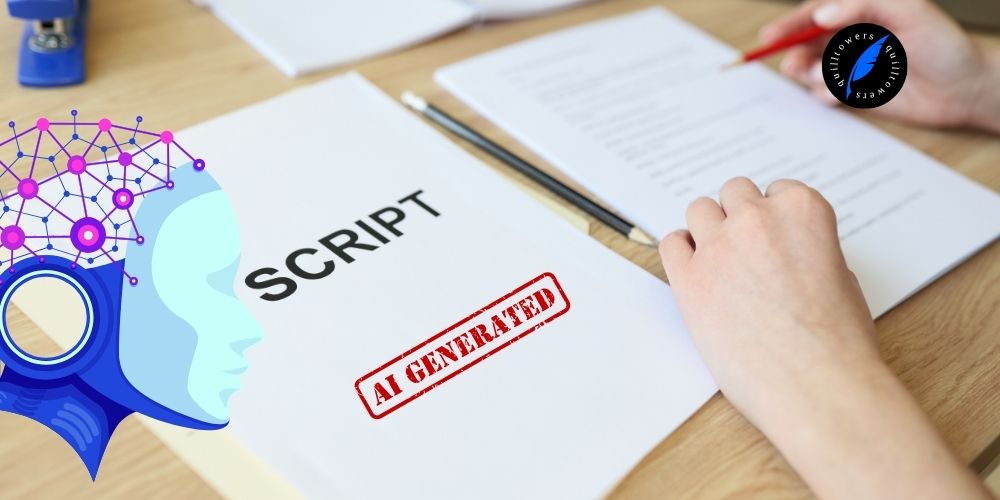
Think about AI scriptwriting as your co-pilot. It can guide, accelerate, and optimize, but you still decide where the journey leads.
Without direction, even the fastest engine circles the runway.
Read more: Electrifying Screenplay Plot Twist Techniques: Surprise Without Losing Your Audience
So how do you turn AI scriptwriting into a system that delivers real results, not just words on a page?
Here’s where structure meets strategy:
Step 1: Define Your Goal and Audience (Conversion Starts Here)
Before you touch any AI scriptwriting tool, pause.
Clarity is your compass.
Ask yourself:
- What action do I want the viewer to take?
- Who am I speaking to?
Without these answers, AI scriptwriting will provide content but not direction.
For example, a script meant to drive clicks will sound very different from one designed to build trust. When your goal is clear, every line in your script pulls in the same direction.
And that’s what turns content into conversion.
Step 2: Generate Ideas and Outlines Using AI
Once your direction is set, this is where AI scriptwriting really shines.
Instead of wrestling with a blank page, you can:
- Generate multiple script ideas in seconds.
- Build structured outlines effortlessly.
- Explore angles you may not have considered.
It’s like opening a door and finding ten paths instead of one.
With AI scriptwriting, creative blocks don’t stand a chance. You move from “What should I write?” to “Which idea should I refine?”, and that shift alone saves time and energy.
Step 3: Craft a Strong Hook (First Few Seconds Matter Most)
If your script were a stage, the hook would be the spotlight.
Miss it, and everything else fades into the dark.
In today’s fast-scrolling world, AI scriptwriting helps you test and refine hooks quickly.
But the principles remain the same.
Your opening must:
- Spark curiosity.
- Address a real problem.
- Promise something worth staying for.
Envision your hook as a handshake. Weak, and the connection slips. Firm, and the conversation begins.
The beauty of AI scriptwriting is that it allows you to generate multiple variations, so you’re not guessing what works. You’re choosing from tested options.
Step 4: Structure Your Script for Engagement
A high-converting script isn’t just written, it’s engineered.
And this is where AI scriptwriting becomes your architect.
A simple, proven structure looks like this:
- Hook → Problem → Solution → Call to Action
This flow mirrors how people think. First, you grab attention.
Then, you highlight a problem.
Next, you offer a solution.
Finally, you guide the next step.
Read more: Powerful Screenplay Opening Scenes: Master the First 10 Pages with Irresistible Hooks
AI scriptwriting helps organize your ideas into this structure, but your role is to refine the rhythm so it feels natural, not mechanical.
Because structure creates clarity, and clarity keeps people watching.
Step 5: Refine and Humanize AI-Generated Content
Here’s where many creators trip.
They generate an AI-written script and stop there.
But AI gives you a draft, not a finished piece.
To make AI scriptwriting truly effective, you need to:
- Add personality.
- Adjust tone.
- Inject emotion and storytelling.
Picture AI as the skeleton. You bring the heartbeat.
This is where your voice, your perspective, and your creativity transform a good script into a compelling one.
Read more: How to Create a Compelling Character Arc That Drives Your Story Forward
Because at the end of the day, people don’t connect with perfection; they connect with authenticity.
Step 6: Add Emotional Triggers and Clear Calls to Action
If structure is the engine, emotion is the fuel.
And this is where AI scriptwriting meets psychology.
Your script should:
- Tap into desires, fears, or aspirations.
- Make the viewer feel seen and understood.
- Guide them toward a clear next step.
Whether it’s subscribing, clicking, or buying, your call to action should feel like a natural continuation rather than an abrupt demand.
Read more: Understanding Scene Structure in Screenplays: How to Build Powerful Moments on Screen
With AI scriptwriting, you can test different emotional angles and CTAs quickly. But the goal remains the same: move your audience from interest to action.
Because conversion happens when logic and emotion meet at the right moment.
The Iteration Advantage: Pro-Level AI Scriptwriting Best Practices
Building scripts with AI scriptwriting is powerful, but using it well is what sets you apart.
Anyone can generate content. Few can refine it into something that resonates, persuades, and converts. That difference lies in how you approach the process.
Read more:10 Screenwriting Mistakes to Avoid as a Beginner
Because with AI scriptwriting, the real advantage isn’t just creation, it’s iteration.
Focus on Intent, Not Just Output
It’s easy to fall into the trap of generating content for its own sake.
But effective AI scriptwriting starts with purpose.
Every script should align with:
- Audience needs.
- Search intent.
- Desired outcomes.
Before you hit generate, ask: What is this script meant to achieve?
When intent leads, your content stops wandering and starts landing exactly where it should.
Avoid Over-Reliance on AI, Blend Human Creativity
Here’s the truth: AI scriptwriting is a tool, not a replacement.
It can give you speed, structure, and suggestions, but it can’t replace lived experience, emotion, or nuance.
The best results come from combining:
- AI efficiency.
- Human insight and storytelling.
Think of it like cooking. AI gives you the ingredients and a recipe, but you bring the flavor.
That balance is what turns functional scripts into unforgettable ones.
Use AI for Iteration, Not Just Generation
Most creators stop at the first draft.
That’s where they lose.
With AI scriptwriting, your first output is just the starting line.
The real magic happens when you:
- Rewrite sections.
- Test variations.
- Improve clarity and flow.
Iteration is where quality sharpens. It’s where rough ideas become refined messages.
And with AI scriptwriting, you can iterate faster than ever, without losing momentum.
Edit for Tone, Clarity, and Authenticity
Even the best AI output needs a human touch.
Because while AI scriptwriting can structure your content, it’s your voice that makes it believable.
Focus on:
- Natural, conversational language.
- Clear and direct messaging.
- An authentic tone that feels human.
If your script sounds like everyone else, it will blend into the noise.
But when it sounds like you, it stands out.

Where Most Scripts Go Wrong (And How to Fix It)
Even powerful tools can yield weak results when used poorly. The difference isn’t the tool, it’s how you use it.
Here’s where most AI scriptwriting efforts fall apart, and how to fix each one:
- Generic, uninspired scripts → Add specificity and voice
- Don’t settle for bland output. Refine your script with real-world examples, unique angles, and a human tone. Your audience should feel like they’re hearing you, not a machine.
- Weak or forgettable hooks → Lead with tension or curiosity
- The first few seconds decide everything. Start with a bold statement, a relatable problem, or a question that immediately pulls the viewer in.
- Missing or unclear calls to action → Guide the next step clearly
- Don’t assume your audience knows what to do next. Tell them clearly and confidently. Whether it’s clicking, subscribing, or buying, make the next move obvious.
These may seem like small gaps, but they create a ripple effect.
Because in AI scriptwriting, it’s not just what you say, it’s how clearly, quickly, and convincingly you say it.
Fix these, and your scripts won’t just exist; they’ll perform.
From Words to Wins
At this point, the pattern is clear.
AI scriptwriting isn’t just a shortcut; it’s a system.
A system that combines:
- Speed.
- Strategy.
- Conversion.
When used right, AI scriptwriting helps you move from scattered ideas to structured, high-performing content.
It gives you the ability to create consistently, refine intelligently, and scale without losing quality.
But here’s the part most people overlook: the longer you wait to master AI scriptwriting, the wider the gap becomes.
Others are already using it to:
- Build authority in their niche.
- Capture attention across platforms.
- Turn content into consistent traffic and results.
And while they’re compounding their growth, hesitation quietly costs you visibility.
But you don’t have to figure it out alone.
Read more: Script vs Screenplay: What’s the Real Difference
At Quilltowers, we don’t just write, we build strategic content systems powered by AI scriptwriting and human insight.
We help you turn ideas into scripts that not only sound good but also drive real results.
So if you’re ready to:
- Create scripts that win, not just exist.
- Build a system that works long after you hit publish.
- Turn your content into a true growth engine.
Now is the moment to act.
Don’t let your ideas stay buried.
Don’t let your content drift unnoticed.
Start using AI scriptwriting strategically today, and let Quilltowers help you turn it into something remarkable.