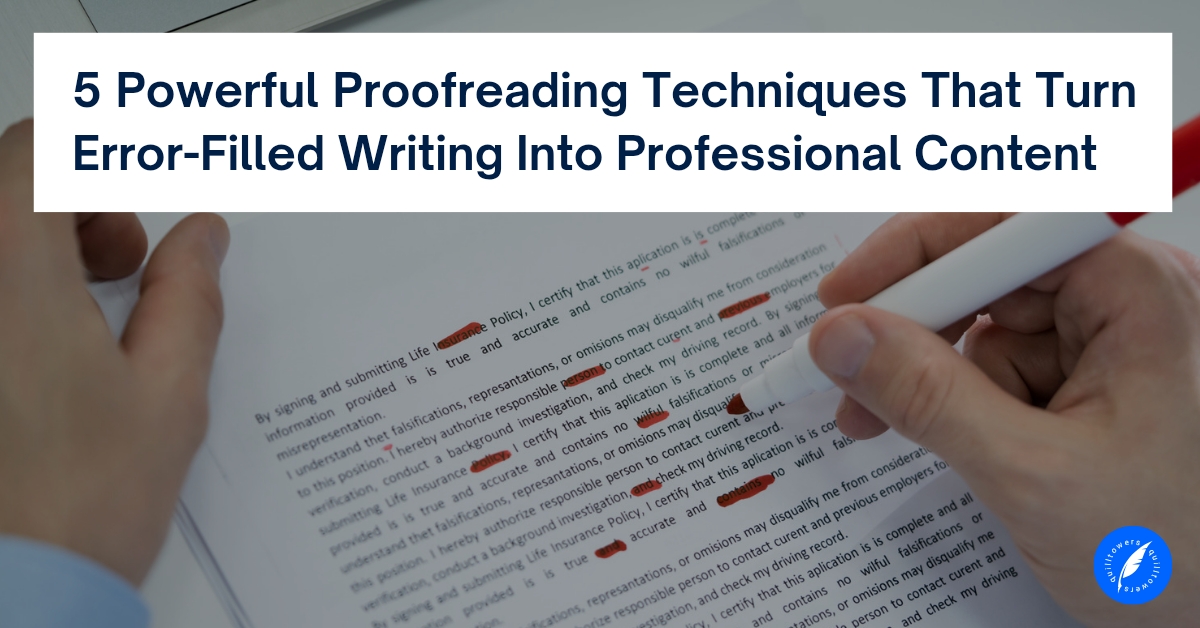
5 Powerful Proofreading Techniques That Turn Error-Filled Writing Into Professional Content
A brilliant idea can open the door, but a careless typo can slam it shut.
Imagine spending hours crafting an insightful article, polishing every argument, and shaping every sentence, only for readers to stumble over misspelled words, awkward phrases, or missing punctuation.
Suddenly, the message that should shine begins to lose its luster. In a world where first impressions can make or break trust, small writing errors can cast a surprisingly long shadow.
That is where proofreading becomes the final line of defense. More than a quick scan for spelling mistakes, proofreading is the quality-control step that helps turn rough writing into clear, polished, professional content.
It gives your words one last careful inspection before they meet the eyes of your audience.
Effective proofreading can sharpen clarity, improve readability, strengthen credibility, and make your content easier to trust. After all, readers should be focused on your ideas, not distracted by errors hiding between the lines.
Think of it as polishing a window: the message is already there, but removing the smudges allows readers to see it clearly.
The good news? You do not need to reread the same paragraph ten times or become a grammar detective with a magnifying glass. With the right proofreading techniques, you can spot common errors faster, strengthen weak sentences, and give your content the professional finish it deserves.
In this guide, we will explore five powerful proofreading techniques that can help you catch overlooked mistakes, improve your writing, and turn error-filled drafts into content that stands tall with confidence.
Because when your words are polished, your ideas get the spotlight they deserve.
1. Read Your Content Slowly to Catch Hidden Errors
Proofreading is more than giving your draft a quick glance before you hit publish. It calls for deliberate attention to the words, sentences, and details that are easy to miss when you already know what the text is meant to say.
Research on proofreading suggests that familiarity with a text can make errors harder to spot. University writing centers also recommend slowing down and treating proofreading as a separate task from simply reading for meaning.
Break the “Fast Reading” Habit
When you write something yourself, your brain already knows the message you want to convey. That can make it surprisingly easy to overlook what is actually sitting on the page. Research on proofreading has found that familiarity with your own writing can make errors harder to detect.
Your brain may start filling in the gaps before your eyes have fully checked the words. In other words, you may read what you intended to write instead of what you actually wrote.
A study published in the Journal of Research in Reading found that greater familiarity with text can increase its predictability, which may contribute to errors being missed during proofreading.
The fix is simple: slow down.
The Texas A&M University Writing Center recommends reading slowly during proofreading. At the same time, Middle Tennessee State University advises writers not to rush, as a slower pace gives them more time to catch mistakes.
Instead of sweeping your eyes across the page, examine each word with intention.
Look for:
- Missing words.
- Repeated words.
- Misspellings.
- Incorrect punctuation.
- Words in the wrong place.
- Words that do not express what you meant.
Look at it as walking into a room with the lights on after it’s been cleaned. From across the room, everything may look spotless. Up close, however, you may notice the dust hiding in the corners.
Proofread One Sentence at a Time
Once you slow your pace, take your proofreading one sentence at a time. This simple shift can stop your brain from racing ahead and help you focus on the details in front of you.
The University of Nevada, Reno recommends reading slowly and isolating individual sentences. Kennesaw State University also recommends reading backwards, one sentence at a time, to help writers focus on sentence-level errors rather than getting carried away by the overall flow.
Read more: 10 Proofreading Mistakes That Are Killing Your Content Credibility
For each sentence, check its structure, spelling, punctuation, grammar, and word choice. The University of Wisconsin–Madison Writing Center recommends checking for different types of errors separately when needed. It provides sentence-level proofreading strategies for issues such as fragments, subject-verb agreement, and punctuation.
Then look beyond grammar. Ask whether the sentence is clear, complete, and useful.
Does it contain an unnecessary word?
Is a key word missing?
Does the sentence say what you actually mean?
Could a reader misunderstand it?
Kennesaw State University recommends checking sentence completeness, punctuation, sentence structure, and word choice during the editing process.
A useful proofreading question is: does this sentence say exactly what I mean, and could anything confuse the reader?
That question turns proofreading from a passive reread into an active quality check. You are no longer simply looking at your words. You are testing whether each sentence does its job.
Read Difficult Sections Aloud
Sometimes your eyes give a sentence a free pass, but your ears catch the problem immediately.
A sentence may look perfectly acceptable on the screen yet sound clumsy when you say it aloud. Texas A&M University’s University Writing Center recommends reading writing aloud because hearing the words can reveal omitted words, misspellings, awkward passages, and other problems that may be harder to notice during silent reading.
Reading aloud can also expose sentences that feel confusing or difficult to follow. Kennesaw State University recommends reading each sentence aloud slowly. At the same time, the University of Nevada, Reno notes that hearing your writing can reveal issues that may be less obvious when you read silently.
Pay attention to the moments when you:
- Stumble over a phrase.
- Pause in an unusual place.
- Lose your train of thought.
- Reread the same sentence.
- Struggle to say a sentence naturally.
These moments are not interruptions. They are clues.
They can signal that the wording, sentence structure, or punctuation deserves another look. In that sense, reading aloud turns your ears into another proofreading tool.
It can also help you hear the rhythm and flow of your writing. Texas A&M University’s University Writing Center explains that hearing your words can help you recognize the rhythm of your prose. That makes reading aloud useful not only for catching mechanical mistakes but also for improving how your writing sounds to readers.
After all, professional content should not merely look polished. It should sound natural too.
The takeaway: Do not let familiarity turn proofreading into a race. Slow down. Isolate one sentence at a time. Read difficult passages aloud. When you stop reading only for what you expect to see and start examining what is actually on the page, hidden errors have far fewer places to hide.
2. Use a Fresh Perspective to Spot Mistakes More Easily
Even careful writers can become blind to errors after spending hours with the same draft.
When you know what you intended to say, your brain can focus on the message instead of the exact words on the page. That is why effective proofreading often starts with one simple move: step away.
The University of Wisconsin–Madison recommends setting text aside before proofreading. In contrast, the University of Waterloo recommends putting your work aside for several hours so the words feel fresh when you return.
Take a Break Before Proofreading
Proofreading immediately after finishing a draft can make small mistakes harder to see. You are still too close to the words, ideas, and structure you have just created.
The University of Wisconsin–Madison Writing Center recommends leaving time between writing and proofreading, noting that even a short break can create enough distance to help writers notice mistakes more easily.
So, resist the urge to hit “publish” the second you finish writing. Step away from the screen.
Take a walk.
Grab a coffee.
Work on another task.
Give your mind a chance to change gears.
The Oregon State University Writing Centre recommends taking a break after drafting or revising to help writers rest before returning to the next stage of the writing process with a fresh perspective.
The more important the piece, the more useful that pause can become. The University of Waterloo recommends setting work aside for several hours before proofreading, while George Mason University suggests letting a paper rest for a few days before reviewing it again.
When you return, pretend you are a stranger reading the piece for the first time. Do not let your memory fill in the blanks. Look at what is actually on the page.
That small mental shift can make a world of difference.
Change How You View the Draft
Sometimes, the problem is not your writing. It is your view of the writing.
After staring at the same document for too long, the page can become as familiar as the back of your hand. Changing its appearance can help break that pattern and give your eyes a new path to follow.
For example, the Oregon State University Writing Center recommends changing the font style, size, or other formatting elements to make familiar text look different. It also recommends printing a document because errors that go unnoticed on a computer screen may be easier to notice on paper.
You can also read your draft backwards, one sentence at a time. This disrupts the article’s natural flow and makes it harder for your brain to be swept along by the overall meaning. Oregon State University and the University of Wisconsin–Madison both recommend this technique for focusing attention on sentence-level errors.
Another useful proofreading trick is to isolate the sentence you are checking. Cover the surrounding lines with a piece of paper or use another visual guide to keep your eyes from wandering.
Oregon State University recommends isolating individual sentences, while George Mason University suggests reading one sentence at a time from the end of a document when checking sentence completeness and other mechanical issues.
And remember: you do not have to catch everything in one pass.
Changing your font, printing the document, reversing your reading direction, or narrowing your visual focus can make familiar writing feel new again. Sometimes, you do not need sharper eyes. You simply need a different window.
Focus on One Error Type at a Time
Trying to catch spelling, grammar, punctuation, formatting, word choice, and clarity all at once can turn proofreading into a mental juggling act.
Instead, give each pass a specific mission. The Oregon State University Writing Center recommends setting proofreading goals and focusing on individual areas such as grammar, word choice, punctuation, and formatting instead of attempting to fix everything simultaneously.
First, check spelling and typographical errors. Look for misspelled words, missing words, repeated words, incorrect capitalization, and common mix-ups such as their, there, and they’re.
Kennesaw State University Writing Center identifies spelling and typographical errors as key proofreading concerns and notes that writers should double-check spell-checker suggestions because automated corrections may not match the intended meaning.
Next, examine grammar and punctuation.
Check for incomplete sentences, subject-verb agreement problems, missing or misplaced punctuation, run-on sentences, and other grammatical errors. Kennesaw State University and the University of Wisconsin–Madison both identify these areas as useful targets during proofreading.
Finally, review clarity, consistency, and word choice.
Ask whether your sentences communicate the intended message. Check that terminology and formatting stay consistent. Look for vague wording, unnecessary repetition, or words that weaken an otherwise strong point.
Read more: Master SEO Copywriting: Power Up Your Brand Growth
Oregon State University lists word choice and formatting as areas writers can target during proofreading, while the University of Waterloo recommends checking style elements such as repetition and word choice.
This one-problem-at-a-time method gives every proofreading pass a clear purpose.
McKendree University recommends focusing on one type of error at a time, as trying to identify and revise too many problems simultaneously can cause writers to lose focus.
The goal is not to stare harder at the same draft. It is to look at it differently.
Take a break.
Change the way the text appears.
Isolate individual sentences.
Give each proofreading pass one clear mission.
When you create distance between yourself and your words, those sneaky errors lose their hiding places, and your polished content has room to shine.
3. Combine Proofreading Tools With Human Judgment
Proofreading tools can speed up the final review, but they work best as assistants, not as replacements for human judgment.
Modern writing tools can flag spelling, grammar, punctuation, clarity, and style issues, giving you a useful first pass over a draft. For example, Microsoft Editor analyzes documents and offers suggestions for spelling, grammar, conciseness, and clarity.
Still, a tool can spot a possible problem without fully understanding what you want to say. Grammarly recommends combining AI proofreading with human review because automated proofreaders may not fully understand context and tone.
Think of these tools as a second pair of eyes, not the captain of the ship. They can point toward trouble, but you still need to decide what belongs in the final version.
Use Grammar and Spell-Checking Tools Strategically
Start your proofreading process by allowing a trusted tool to scan your draft for obvious mechanical errors. Tools such as Microsoft Editor can identify spelling and grammar problems while also offering suggestions related to clarity, conciseness, and style.
This can save time by quickly bringing potential problems to your attention. However, do not treat every highlighted word as a mistake. Microsoft notes that its suggestions may not always match a writer’s style and allows users to accept, ignore, or customize recommendations.
Think of automated proofreading as your first line of defense, not the final authority.
Let the tool flag possible spelling, grammar, and punctuation issues. Then step in and decide whether each suggested change actually improves the sentence.
This human check matters most when a sentence depends on context, meaning, tone, or a deliberate stylistic choice. Grammarly acknowledges that AI proofreaders can quickly identify many sentence-level issues but recommends human evaluation for context and tone.
For example, a writing tool may flag a sentence because it does not follow a common pattern. That does not automatically mean the sentence is wrong. You may have chosen that structure intentionally to create emphasis or match your brand voice.
Good proofreading is not about obeying every red or blue underline. It is about knowing when a suggestion improves the writing, and when it simply gets in the way.
Verify Every Suggested Correction
Never click “Accept All” and assume your draft has suddenly become flawless. A proofreading suggestion is a recommendation, not an order.
Microsoft Editor gives writers the option to accept or ignore individual suggestions and notes that its recommendations may not always suit a writer’s style.
Before accepting a correction, read the entire sentence again.
Then ask:
- Does the change preserve my intended meaning?
- Does it fit the surrounding context?
- Does the sentence still sound natural?
- Does it match my brand voice?
- Does the correction actually fix a problem?
Imagine a tool suggests replacing a word with a simpler alternative because it thinks the sentence could be more concise. The suggestion may be technically reasonable, but that original word might have been chosen carefully to express a specific idea or create a particular tone.
Accepting the change could make the sentence shorter but weaken the writing.
The same principle applies to voice.
Grammarly recommends human evaluation alongside AI proofreading because automated tools lack the contextual and tonal understanding that human reviewers have.
So, question every suggestion before accepting it.
If the change makes your writing clearer and more accurate, keep it. If it changes your meaning, flattens your personality, or makes the sentence sound unlike you, leave it on the cutting-room floor.
Build a Personal Error Checklist
After several rounds of proofreading, you will likely notice a pattern in the mistakes you make most often.
Maybe you mix up similar words. Perhaps commas keep sneaking into places they do not belong. Or maybe you have a habit of repeating the same phrase.
Do not rely on memory alone. Turn those recurring problems into a personal proofreading checklist.
Your checklist might include:
- Spelling: Check frequently misspelled words and common typos.
- Grammar: Review subject-verb agreement, sentence fragments, verb tense, and commonly confused words.
- Punctuation: Check commas, apostrophes, quotation marks, and sentence-ending punctuation.
- Word choice: Remove vague, repetitive, or unnecessary wording.
- Consistency: Check terminology, capitalization, formatting, and style.
- Clarity: Make sure each sentence communicates its intended meaning.
- Final details: Verify names, numbers, links, headings, and other important information.
A checklist gives your proofreading process a repeatable structure instead of forcing you to remember every possible issue each time. Microsoft Editor also allows users to customize the types of issues it checks, helping tailor your review to the problems most relevant to your writing.
Read more: B2B Copywriting: How to Shorten Long SaaS Sales Cycles
You can make your checklist even more personal by building it around your recurring errors. If you often confuse similar words, overuse commas, forget articles, or repeat phrases, turn those weak spots into permanent checkpoints.
Before publishing an important piece, run your draft through the checklist after the automated tool has completed its scan. This creates a two-layer proofreading process: technology helps uncover potential mechanical problems, while human judgment decides whether the final content is accurate, clear, consistent, and true to your voice.
The goal is not to choose between proofreading technology and human expertise. It is to use both intelligently.
Let technology catch what it does well. Then take the wheel. Your judgment gives the words their meaning, personality, and purpose, and that is what turns a corrected draft into truly professional content.
4. Proofread for Clarity, Consistency, and Professionalism
Catching typos is only one piece of effective proofreading. Polished content should also be clear, concise, consistent, and easy to follow.
The University of Wisconsin–Madison recommends removing unnecessary words before checking for smaller errors, while Purdue University’s Writing Lab emphasizes that clear sentences help writers communicate their meaning effectively.
Look at proofreading as polishing a mirror. Fixing a typo removes one smudge, but improving clarity and consistency cleans the entire surface so readers can see your message without distraction.
Eliminate Unnecessary Words
Wordiness can bury a strong point beneath phrases that add little value. During proofreading, look for words that slow the reader down without adding meaning.
Purdue University recommends removing redundant words and replacing unnecessarily long phrases with shorter alternatives when the shorter version communicates the same idea.
For example:
Wordy: At this point in time, the writer is able to make improvements to the article.
Concise: Now, the writer can improve the article.
The goal is not to chop every sentence down to the bone. Good proofreading preserves useful detail while removing words that get in the way.
The University of Wisconsin–Madison specifically recommends eliminating unnecessary words when developing clear, concise, direct sentences.
Watch for repetition and filler phrases, too. If two words or phrases express nearly the same idea, one may be doing unnecessary heavy lifting. Purdue’s guidance on concise writing recommends checking whether words are necessary and distinct rather than allowing redundant wording to remain.
Also replace vague or inflated wording with precise language when you can. The University of Wisconsin–Madison recommends avoiding vague nouns and unnecessarily inflated words to develop clear, concise sentences.
A simple proofreading question can help: Can I say this more directly without losing the meaning?
If the answer is yes, tighten the sentence. Your readers will thank you for it.
Check Consistency Throughout the Content
A professional piece should feel like one cohesive document, not a patchwork quilt of sentences written at different times.
During proofreading, check your terminology, capitalization, punctuation, formatting, and headings for consistency. Small inconsistencies may seem harmless, but when they pile up, they can make content feel less polished.
Pay special attention to terms that appear throughout the article. If you call something a “content strategy” in one section and a “content plan” in another, make sure the difference is intentional. Otherwise, choose one term and stick with it.
The same principle applies to formatting.
Check your:
- Headings and subheadings.
- Bullet and numbered lists.
- Quotation marks.
- Hyphenation.
- Capitalization.
- Numbers.
- Formatting patterns.
Grammar and verb tense deserve the same attention. If you describe an ongoing process in the present tense, do not suddenly switch to the past tense without a clear reason.
Likewise, keep your tone consistent unless a deliberate shift serves the content.
The University of Wisconsin–Madison recommends checking different categories of errors separately and using a systematic proofreading process instead of trying to catch everything at once.
And do not leave headings and transitions out in the cold.
Meaningful headings help readers understand the structure of your content, while useful transitions show how ideas connect. The University of Wisconsin–Madison recommends choosing transitions that accurately reflect the logical relationship between ideas rather than adding them mechanically.
A good transition should feel like a bridge, not a roadblock.
Make Every Sentence Easy to Understand
A sentence can be grammatically correct and still leave readers scratching their heads. That is why your final proofreading pass should ask more than “Is this correct?”
Ask:
“Is this clear?”
Purdue University’s Writing Lab explains that clear sentences help ensure a writer’s message is understood as intended and can also make writing more engaging and persuasive.
Read more: 12 Powerful Content Strategy Hacks to Outrank Competitors Fast
Start by looking for sentences carrying too many ideas at once. The University of Wisconsin–Madison identifies sentence sprawl as a common problem in which too many equally weighted phrases and clauses make sentences tiring and less clear.
When a sentence becomes overloaded, give it some breathing room. Break it into two sentences so each idea has space to land.
For example:
Overloaded: Proofreading helps writers catch errors before publication and improves clarity, consistency, and readability, making content easier for audiences to understand and engage with.
Clearer: Proofreading helps writers catch errors before publication. It can also improve clarity, consistency, and readability, making the content easier to understand.
Still, do not treat every long sentence as a problem. Variety gives writing rhythm.
Purdue’s guidance on sentence structure emphasizes using varied sentence structures purposefully to clearly communicate relationships between ideas.
Finally, examine the transitions between sentences and paragraphs. Readers should not have to build the bridge between your ideas themselves. Use transitions when they clarify relationships such as contrast, cause and effect, sequence, or addition.
The University of Wisconsin–Madison recommends using transitions strategically and selecting words that accurately reflect the logical relationship between ideas.
For online content, this clarity becomes even more important because readers often scan rather than read every word. Nielsen Norman Group recommends concise language, short paragraphs, and formatting that supports scanning, including meaningful headings and other visual cues.
The takeaway: Professional proofreading goes far beyond hunting for typos.
Remove unnecessary words.
Keep your formatting and terminology consistent.
Break up confusing sentences.
Strengthen the connections between ideas.
When every sentence earns its place and every section follows a clear path, your content stops feeling like a rough draft and starts reading like something built to last.
That is the difference between writing that merely gets published and writing that earns attention.
5. Perform a Final Pre-Publishing Proofreading Check
Your final proofreading pass is your last chance to catch problems before your content reaches readers. Do not use this stage only to hunt for typos.
Review the article as a complete piece of communication and make sure its message, structure, links, images, and supporting details work together.
This final check matters even more for web content because important elements are often located outside the main body. Page titles, descriptions, links, and image text can all shape how users understand and interact with a page.
Google recommends descriptive titles and meta descriptions, while its guidance on links and images emphasizes descriptive anchor text and useful alt text.
Think of this stage as the last sweep before opening the doors. The furniture is already in place; now you are checking the windows, straightening the picture frames, and making sure nothing has been left lying around.
Review the Beginning and Ending Carefully
Start your final proofreading check with the introduction.
Ask yourself: Does it deliver what the headline promises?
Your opening should accurately establish what readers will learn rather than create an expectation the article fails to meet. Google recommends descriptive title elements that accurately reflect a page’s content, reinforcing the importance of keeping your headline, page title, and actual content aligned.
Then give your conclusion the same careful attention.
Does it reinforce the main message?
Does it give readers a clear takeaway?
Does the call to action feel connected to what they have just learned?
A strong ending should not suddenly introduce a new idea that feels like it wandered in from another article. It should bring the reader back to the central point and show them what to do next.
Read more: Why Most Content Writing Efforts Fail, And How Successful Brands Get It Right
After that, read the entire article from beginning to end without editing. This gives you a chance to experience the piece as a reader rather than constantly stopping to fix individual words.
Notice anything that feels awkward, repetitive, abrupt, unfinished, or out of place. If a sentence suddenly trips you up or a final typo jumps off the screen, stop and fix it.
Check Every Content Element
Do not stop proofreading when the body copy looks clean. Every visible and search-facing element deserves a final check. Once the body copy is clean, turn your attention to the elements surrounding it.
These details may seem minor, but they can affect readability, accessibility, usability, and search visibility. Give each of the following a final check before publishing.
- Headings and subheadings: Make sure they accurately describe the sections beneath them and follow a logical hierarchy. Google notes that headings and other prominent text can contribute to how it determines a page’s title link, so your primary heading should clearly represent the page.
- Links and anchor text: Test important links and ensure their anchor text tells readers what to expect after clicking. Google recommends descriptive, reasonably concise, and relevant anchor text rather than vague phrases.
- Images, captions, and alt text: Check that images are relevant to the surrounding content and that important images have useful alternative text. Google explains that alt text helps describe images for people who cannot see them, including screen reader users, and helps Google understand an image’s subject.
- Numbers, names, statistics, and quotations: Verify these details against their original sources before publishing. Never rely on memory when a precise figure, name, quotation, or factual detail can be checked.
- Meta title: Make sure the page title is descriptive, concise, relevant to the page, and not keyword-stuffed. Google recommends unique, descriptive title elements and warns against keyword stuffing.
- Meta description: Review the description to ensure it accurately summarizes the specific article and gives searchers a useful reason to click. Google says meta descriptions can sometimes be used to generate search-result snippets and recommends creating unique, descriptive descriptions for individual pages.
There is one important detail to remember: Google does not guarantee that it will display your exact meta description in search results.
Google primarily generates snippets from page content and may use the meta description when it provides a more accurate description.
That means your proofreading should not stop at the metadata. Your actual page content still needs to clearly communicate the value.
Use a Final Proofreading Checklist
Before you publish, give your article one final systematic inspection:
- Spelling: Are words spelled correctly, including names, technical terms, and brand names?
- Grammar: Are sentences complete and correctly constructed?
- Punctuation: Are commas, periods, apostrophes, quotation marks, and other punctuation marks used correctly?
- Formatting: Are headings, lists, bold text, spacing, and other formatting elements consistent?
- Readability: Can readers understand the message without untangling unnecessarily complicated sentences?
- Consistency: Are terminology, capitalization, spelling, tense, tone, and formatting consistent throughout?
- Links: Do important links work, and does each link use descriptive anchor text? Google recommends crawlable links with descriptive anchor text that is relevant to the destination.
- Factual details: Have you verified important names, numbers, statistics, dates, quotations, and other factual information against reliable sources?
Once the mechanical checks are complete, change hats.
Read the article as a reader, not as its writer.
Would the opening make sense to someone unfamiliar with the topic?
Does anything feel repetitive?
Is there a sentence that makes you pause for the wrong reason?
Does the conclusion deliver a satisfying finish?
Does the article give readers a clear reason to trust the information and act on it?
This reader-focused stage is one of the most valuable parts of proofreading because a spelling and grammar check cannot judge the entire experience. A technically correct article can still feel confusing, disjointed, or lifeless.
The takeaway: Treat pre-publishing proofreading as your content’s final quality-control gate. Do not ask only whether the words are correct.
Ask whether the entire piece is clear, credible, consistent, useful, and ready for readers.
Once every detail passes that test, your content can step into the spotlight with confidence, polished, purposeful, and ready to make the professional impression your ideas deserve.
Why Effective Proofreading Matters More Than You Think
A single typo may seem harmless, but a trail of errors can slowly chip away at a reader’s confidence. Effective proofreading helps protect your credibility by making sure your message is clear, polished, and easy to understand.
And proofreading is about more than fixing spelling and grammar. It can strengthen professionalism, readability, and reader engagement by removing distractions that compete with your ideas.
When your content is clean and consistent, readers can focus on what you came to say rather than having to stop to decode what went wrong.
See your writing as a storefront window. Your ideas are the products inside, but smudges on the glass can make them harder to see. Good proofreading clears that glass so your expertise can take center stage.
The goal is not to make every sentence flawless. It is to make your writing clear, credible, and publication-ready, so your ideas leave the impression they were meant to make.
Turn Your First Draft Into Content Worth Reading
Great content should not be held back by avoidable errors. With these five proofreading techniques- slowing down, taking a fresh perspective, combining tools with human judgment, improving clarity and consistency, and completing a final pre-publishing check- you can turn an error-filled draft into polished, professional content.
The key is consistency. Make proofreading a regular part of your publishing workflow, not a last-minute chore squeezed between editing and hitting “publish.” A few intentional checks can help you catch the small mistakes that might otherwise cast a shadow over strong ideas.
Remember, your ideas may earn the click, but polished writing gives readers a reason to stay.
If you are ready to stop letting avoidable errors stand between your ideas and the audience you want to reach, contact Quilltowers today.
Our writers, editors, and proofreaders can help transform your drafts into clear, credible, publication-ready content that reflects your brand’s quality.
Your best ideas deserve more than a quick upload. Give them the polish they need to be remembered.