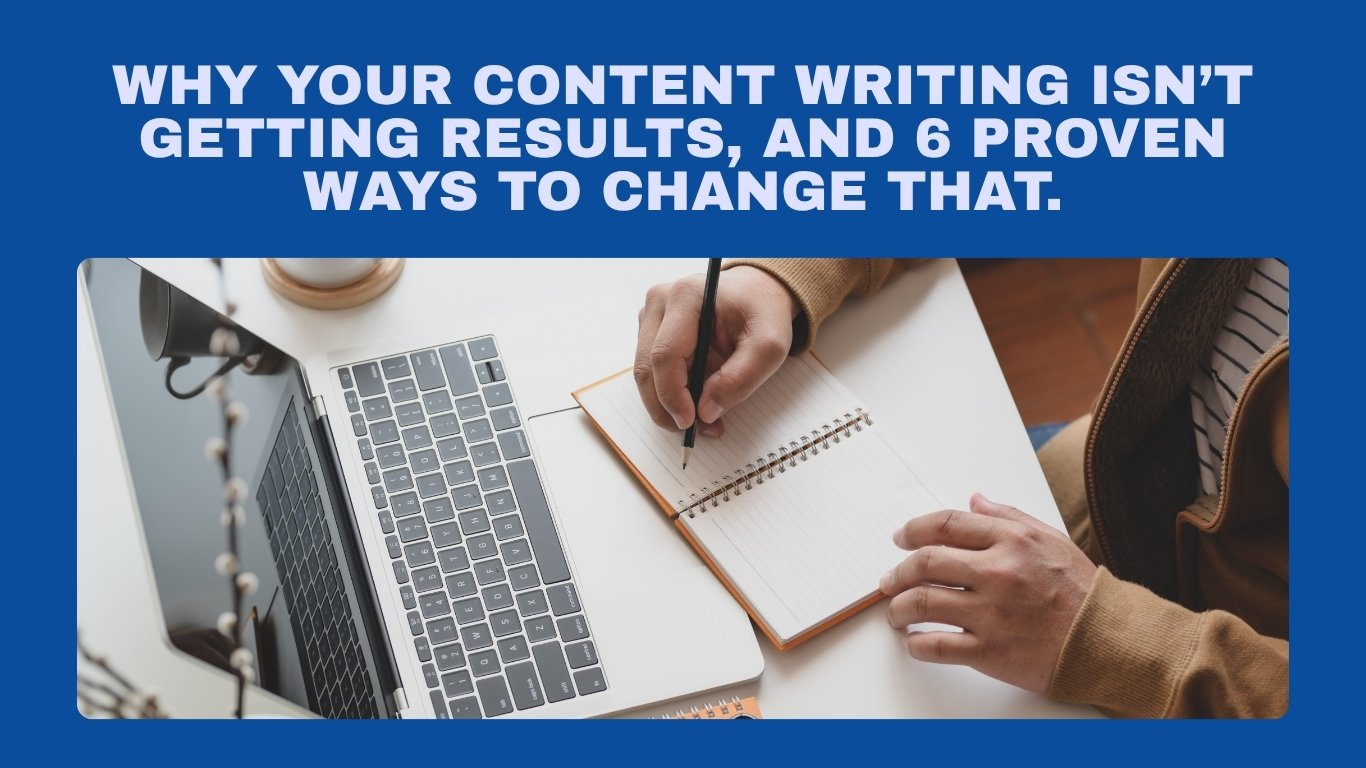
Why Your Content Writing Isn’t Getting Results, and 6 Proven Ways to Change That
You publish the article. You hit “publish.” Then…crickets. The traffic barely moves, engagement feels like a ghost town, and the conversions you hoped for never show up.
If that sounds familiar, your content writing may not be failing because you need more of it. You may simply need content that works harder and has a clearer purpose.
After all, a website can be packed with blog posts and still struggle to attract the right audience. Google’s guidance emphasizes creating helpful, reliable, people-first content that serves a real audience rather than producing large amounts of content mainly to gain search traffic.
View content writing like building a bridge. One side holds your audience, their questions, problems, needs, and goals. The other holds your business, your expertise, solutions, products, and services.
If the bridge connects those two sides, your content can guide readers somewhere meaningful. If it doesn’t, even beautifully written words can leave people stranded halfway across.
That is where strategic content writing changes the game. Instead of creating content simply because the calendar says it is time to publish, you create with a reason.
You understand who you are speaking to, what they are searching for, what information they need, and what action makes sense next.
Google specifically recommends asking whether readers will leave your content feeling they have learned enough to achieve their goal and whether they had a satisfying experience.
The good news? You don’t have to throw everything overboard and start from scratch. Sometimes, the difference between content that sinks and content that gains traction comes down to a few strategic changes.
In this article, we’ll explore six proven ways to strengthen your content writing: understanding your audience and matching search intent, writing stronger introductions, making every paragraph earn its place, guiding readers to the next step, and using performance data to improve what you create.
Your content should not simply take up space on your website. It should have somewhere to go and give your readers a reason to come along.
The path forward starts with turning words into something that works.
Is Your Content Writing Falling Flat? 4 Red Flags to Look For
Publishing content consistently doesn’t guarantee it will attract the right readers, hold their attention, or move them closer to becoming customers.
When content writing falls short, the problem is often not a lack of effort. Instead, the content may not align with what readers need, what they search for, or what the business wants to achieve.
That means the answer may not be another article or a longer publishing schedule. Before you create more content, take a closer look at what your existing content is actually doing.
Is it solving a problem?
Is it reaching people through the right searches?
Does it keep readers interested?
And does it give them a clear reason to take the next step?
These four warning signs can reveal where your content writing is losing momentum, and what needs to change before you publish another piece.
Your Content Writing Isn’t Solving a Clear Reader Problem
Useful content writing begins with understanding the person on the other side of the screen. Before choosing a topic, ask yourself one simple question: What problem is this content helping my reader solve?
There is a world of difference between writing about a subject and creating content that actually helps someone do something, understand something, or make a decision. A blog post can explain a topic accurately and still fall flat if the reader reaches the end without a useful answer or a clear next step.
Google encourages content creators to consider whether they have an intended audience who would find the content useful and whether readers leave with enough information to achieve their goal.
That means effective content writing should begin with the audience, not the blank page.
For example, writing about “email marketing” is broad. Writing about “how to write an email subject line that gets more opens” speaks to a much clearer need. The first identifies a subject; the second tackles a problem.
This distinction matters because readers rarely search the web just to admire a topic. They usually want an answer, a solution, an explanation, or a way forward.
Read more: Why Most Content Writing Efforts Fail, And How Successful Brands Get It Right
When your content writing understands your audience’s questions, frustrations, goals, and level of knowledge, every paragraph has a job to do. You are no longer adding more words to an already crowded internet. You are giving readers a reason to stay, learn, and trust your expertise.
And once you know the problem your content needs to solve, another question comes into focus: How will the people who need that answer find it?
Your Content Lacks a Strong Search and Content Strategy
Even valuable content writing can struggle without a clear strategy. You may have useful ideas and genuine expertise, but if those ideas are disconnected from what your audience is looking for, your content can miss the very people you want to reach.
This is where SEO comes in. It does not have to turn your writing into a technical maze. At its core, SEO helps search engines understand your content and helps people find information relevant to their searches.
Google recommends using the words people would use to find your content and placing them in prominent, descriptive locations, such as the page title and main heading.
But there is an important line to draw here. SEO should support good content writing, not replace it.
Google explicitly recommends creating people-first content rather than content made primarily to attract search-engine visits. It also notes that SEO can be useful when it is applied to content created for people.
In other words, do not build your article around a keyword and then squeeze a few useful thoughts into the gaps. Build it around the reader’s need, then use SEO to make that useful content easier to discover.
Your content writing should bring together two things:
- What your audience wants to know.
- What your audience is actually searching for.
Suppose your audience wants practical ways to improve website conversions. An article filled with broad observations about “the importance of websites” may be related to the topic, but it may not answer the specific need behind the search.
Your topic choices should therefore have a purpose. Instead of asking, “What can we publish this week?” ask, “What does our audience need help with, and how can we provide a genuinely useful answer?”
That small change can transform a content calendar from a bucket of random ideas into a strategic roadmap.
And strategy gets you through the door. But once readers arrive, your content writing still has another job: make them want to stay.
Your Content Is Informative but Not Engaging
Facts can build credibility, but information alone does not automatically make content writing compelling. Readers still need a reason to care, understand how it applies to them, and keep moving through the page.
A weak introduction can make a strong article feel ordinary. Generic language can make useful advice sound forgettable. Poor transitions can also make readers feel as if they are jumping from one disconnected thought to another.
Google’s guidance encourages creators to consider whether their content provides substantial value, insightful information, and a satisfying experience, rather than simply repeating information that already exists elsewhere. That is why engaging content writing needs more than a stack of facts.
A strong opening can quickly establish the problem. Specific examples can turn an abstract idea into something readers can picture. Short, purposeful paragraphs can keep the information moving. Stories, comparisons, questions, and relevant details can also add personality to otherwise dry information.
Think of it this way: information tells readers something; engaging writing gives them a reason to discover what comes next.
Your goal is not to turn every business article into a blockbuster movie. It is to make the information feel relevant, readable, and worth the reader’s limited attention.
After all, even the most valuable advice can gather dust if it never holds the reader long enough to reach the point.
That brings us to another problem that often hides in plain sight: content that informs and engages but never tells readers where to go next.
Your Content Has No Clear Purpose or Conversion Path
Every piece of content writing should have a reason for existing. Perhaps you want to educate potential customers, demonstrate expertise, generate leads, encourage sign-ups, introduce a service, or guide readers toward another useful resource.
Without a clear purpose, even well-written content can leave readers standing at a crossroads with no sign pointing the way. Google recommends considering a page’s primary purpose and whether its main content directly helps it achieve that purpose.
That purpose should influence what you ask readers to do next.
If an article is designed to generate leads, for example, the next step might be to request a consultation or complete a form. If the goal is education, the next step could be to read a related guide or explore another resource.
The call to action does not need to shout. It simply needs to make sense.
This is also where measurement matters. Google Analytics lets businesses measure interactions through events and identify key actions, helping them understand how users interact with a website and evaluate what matters to the business.
That makes it easier to connect content writing with measurable business outcomes rather than treating every article as successful simply because it was published.
A vague ending such as “Contact us today to learn more” may not give readers enough context or motivation. A more purposeful CTA tells them what to do, why it matters, and what they can expect next.
For example, instead of ending a guide with a generic invitation, you could connect the next step directly to the problem the article addressed: Need help turning scattered ideas into strategic content? Talk with our team about creating Content Writing that serves both your audience and your business goals.
The difference is subtle, but important. One simply asks for contact. The other gives the reader a reason to take action.
When your content writing has a clear destination, the reader’s journey doesn’t have to end with the final sentence.
Now that you can spot the warning signs, the real opportunity is to act. Weak audience alignment, unclear strategy, forgettable presentation, and missing conversion paths are not dead ends. They signal where your content writing can become sharper, more useful, and more effective.
The next step is to turn those weak points into a strategy that gives your content a stronger chance of doing the job it was created to do.
6 Proven Frameworks to Upgrade Your Editorial Performance
Once you know what is holding your content writing back, you can stop guessing and start making deliberate improvements.
Strong content rarely happens by accident. It comes from understanding the audience, aligning content with search behavior, communicating value clearly, and learning from how people respond to what you publish.
The good news is that improving your content writing doesn’t require reinventing the wheel. A few focused changes can turn a wandering content strategy into one with direction, purpose, and momentum.
1. Start With Your Audience’s Real Problems
Before you write a single paragraph, find out what your audience actually needs. Research the questions they ask, the challenges they face, the information they are trying to find, and the goals they want to achieve.
Your content writing becomes more useful when it is built around those real needs rather than whatever topic happens to sound interesting to your business. Google recommends asking whether you have an intended audience who would find your content useful if they came directly to your site and whether readers will leave with enough information to achieve their goal.
That means there is a difference between choosing a topic and identifying a problem.
“Content marketing” is a topic. “How can a small business create a content strategy with a limited budget?” is a problem someone may actively want to solve.
Explore our 7 Powerful Content Writing Secrets That Turn Casual Readers Into Loyal Customers
Search behavior can also reveal the language people use when looking for answers. Google describes SEO as helping search engines understand your content and helping users find your site through search.
Google Search Console can also show how a site’s pages perform in Google Search, including queries and impressions that can inform content decisions.
Use those insights to shape your content writing around genuine reader needs. When your content answers a question your audience actually cares about, every section has a clearer reason to exist.
Once you understand the problem, another piece of the puzzle is how your audience searches for the solution.
2. Write for Search Intent, Not Just Keywords
A keyword can tell you what someone typed. Search intent helps you think about what they were hoping to find.
If someone searches for “content writing services,” they may be looking for a service provider. Someone searching for “how to write website content” may instead want instructions.
Treating both searches as though they require the same type of article can lead to content that mentions the right keyword but misses the reader’s actual expectation.
Your content writing should therefore align the topic, format, depth, and answer with the purpose behind the search. Google recommends creating content primarily for people rather than producing search-engine-first pages designed mainly to attract visits from search engines.
Use your primary keyword naturally, but do not force it into every sentence. Instead, cover the related questions, concepts, and information a reader would reasonably expect from a complete answer.
Google specifically identifies keyword stuffing as a practice that can violate its spam policies and recommends writing naturally for users rather than filling pages with excessive keywords.
The result is content writing that serves two audiences at once: the person searching for an answer and the search engine trying to understand what your page offers.
But even perfectly aligned content can struggle if the headline fails to earn the click.
That brings us to the next framework.
3. Create Stronger Headlines and Introductions
You have only a moment to convince a reader that your content deserves attention. Your headline and opening should make the value of the article clear instead of making readers work to figure out why they should continue.
A strong headline can use specificity, a clear benefit, a compelling problem, or curiosity. But a fine line separates curiosity from confusion. Your headline should promise something the article genuinely delivers.
Google recommends descriptive, concise title text and explains that title links help users understand what a search result contains and why it may be relevant to their query. Google also recommends that titles accurately describe the page rather than using exaggerated or shocking language.
The same principle should guide your introduction. Tell readers what problem you are addressing, establish why it matters, and give them a reason to continue.
Avoid opening with a long warm-up that takes several paragraphs to reach the point.
Your reader clicked because they wanted something. Show them quickly that they are in the right place.
A useful opening might:
- Identify a problem the reader recognizes.
- Promise a clear benefit.
- Introduce an important question.
- Offer a surprising but relevant insight.
- Show the reader what they will learn.
Look at your headline as the front door and your introduction as the person who welcomes readers inside. If the door looks confusing or the welcome takes too long, visitors may turn around before they see what you have to offer.
Once you have earned those first few moments of attention, the next challenge is keeping it. That means making sure every paragraph pulls its weight.
4. Make Every Paragraph Useful and Engaging
Every paragraph should earn its place. If a sentence does not explain, clarify, demonstrate, support, or move the reader forward, ask yourself whether it truly belongs.
Cutting filler and repeated ideas can sharpen your content without making it thinner.
Google encourages creators to provide original information, substantial value, and a complete description of a topic rather than simply summarizing what others have already said.
That gives you plenty of room to make your content writing more engaging. When an idea feels abstract, bring it to life with an example. When a concept feels complicated, use an analogy to make it easier to grasp.
When evidence strengthens your point, include a relevant statistic. And when a brief story can make a lesson more memorable, use one.
The goal is not to decorate your content writing with extras. It is to choose the right detail at the right moment.
You also want readers to move through the page with ease. Break dense blocks of text into focused paragraphs, use meaningful subheadings, and create a natural path from one idea to the next.
Google recommends descriptive headings that help users understand the content and cautions against unnecessary repetition.
Think of each paragraph as a stepping stone. One should lead naturally to the next, giving the reader a clear reason to keep moving. When every paragraph carries its weight, your content becomes easier to read, easier to trust, and far more likely to hold attention.
5. Add a Clear Purpose and Compelling CTA
Good content writing should lead somewhere. Before publishing, decide what you want the reader to do after consuming the content.
Depending on the article’s purpose, that next step might be reading another resource, joining an email list, downloading a guide, requesting a consultation, or exploring a relevant service.
Google’s people-first guidance asks whether content has a clear purpose and whether readers leave feeling they have learned enough to achieve their goal.
That principle can shape your CTA, too.
Your call to action should feel like a natural continuation of the article rather than an unrelated sales pitch. If your content writing has just helped a reader understand why their website content is underperforming, for example, the next logical step could be an invitation to get professional content-writing support.
The strongest CTAs connect the problem you just helped solve with the next solution you can provide.
That connection matters because readers should not have to wonder, “What now?” Your content writing has already moved them from a problem toward an answer. The CTA simply shows them the next step.
This is where content writing can become more than a traffic-generating exercise. When content educates, builds trust, and gives readers a relevant next step, it can become part of a broader customer journey.
In other words, do not tack a CTA onto the end like an afterthought. Build toward it.
6. Edit, Measure, and Improve What You Publish
Publishing is not the finish line. It is the moment your content writing gets a chance to prove itself.
Start by editing with a critical eye. Remove repetition. Tighten unclear sentences. Strengthen weak sections. Check whether the introduction delivers on the headline’s promise.
Most importantly, make sure the article actually answers the question it set out to address.
Then look at the data.
Google Analytics provides engagement metrics that show how users interact with your website, while key events help you identify actions that matter most to your business.
Depending on your goals, useful signals can include organic search traffic, engagement rate, views, average engagement time, and key events. Google Analytics reports these types of metrics across its reporting tools, giving you different ways to examine how people find and interact with your content.
If a particular page has weak engagement, investigate before you abandon it. Google Analytics recommends using reports and Explorations to dig deeper into low engagement and determine whether the issue is connected to particular pages, channels, source/medium combinations, or other factors.
You can also use path exploration to see what users do before or after visiting a particular page. That can help you spot where readers continue, where they drop off, and whether your next-step content makes sense for their journey.
That kind of analysis turns content writing into a learning process rather than a one-and-done task.
And resist the temptation to solve every content problem by simply publishing more. Google specifically warns against producing lots of content across many topics simply in the hope that some of it will perform well in search. Instead, it recommends focusing on helpful, people-first content that serves users.
Sometimes the smartest move is not another article.
It is improving the one you already have.
Better content writing is not about publishing endlessly. It is about creating content with a clear purpose, improving what does not work, and giving readers a reason to return.
When you combine audience insight, search intent, compelling writing, purposeful CTAs, and continuous improvement, your content writing can stop being something you simply publish, and start becoming an asset that works harder for your business.
Build an Audience-First Growth Asset: Turn Content Writing Into a Growth Engine
Content writing becomes far more powerful when it stops being another task on the publishing calendar and starts serving a clear business purpose.
Read more: 15 Proven Content Writing Mistakes That Are Silently Killing Your Traffic
Strategic content can help businesses attract relevant audiences, demonstrate expertise, keep readers engaged, and guide potential customers toward meaningful actions.
HubSpot’s content marketing guidance emphasizes attracting, educating, and engaging target audiences while using content to build brand awareness and increase conversions.
The key is to stop treating every article, blog post, or landing page as an isolated piece. Good content should connect what your audience needs with what your business offers.
Understand Audience Problems
Before writing a single paragraph, identify what your audience is trying to solve, understand, or accomplish.
Instead of asking, “What should we publish this week?” ask, “What does our audience need help with right now?”
That simple shift can turn content writing from a collection of disconnected topics into a useful resource that speaks directly to the people your business wants to reach.
Google encourages creators to consider whether their content gives readers enough information to achieve their goals and whether the overall experience leaves them satisfied.
So, look beyond demographics and surface-level topics. Pay attention to the questions people ask, the problems they face, the language they use, and the outcomes they want.
When your content writing addresses genuine audience problems, every article has a clearer reason for existing. It can educate the reader while naturally showing how your products or services may help them move forward.
In other words, do not start with the blank page. Start with the person waiting for an answer.
2. Match Search Intent
Creating useful content also means understanding what people are actually looking for when they enter a search query.
A keyword can tell you what someone typed. Search intent helps you think about why they typed it.
For example, someone searching for “how to improve website content” may want practical steps, examples, or a process they can follow. Someone searching for “content writing services” may be much closer to comparing providers or looking for professional help.
Your content writing should respond to that underlying need rather than simply repeating the target keyword throughout the article.
Google’s SEO guidance recommends thinking about the words readers may use to find your content and making your site easier for search engines to understand.
That does not mean stuffing keywords into every paragraph. It means creating useful, relevant content that clearly addresses the topic and the reader’s purpose.
Google also emphasizes that its systems are designed to return relevant, useful results based on what people search for.
When content writing aligns with search intent, you are no longer writing merely to rank. You are writing to answer the question behind the search.
That’s a much stronger foundation for both visibility and reader trust.
3. Strengthen Headlines and Introductions
Your headline and introduction have a small window to do a big job: make the value of your content writing clear quickly.
Google explains that title links help users understand what a search result contains and why it may be relevant to their query. It recommends descriptive, concise titles that accurately represent the page.
That means your headline should tell readers what they can expect without making promises the article cannot deliver.
The introduction then needs to deliver on that promise. Identify the problem. Create interest. Show the reader why the information matters. Then give them a reason to continue.
Avoid opening with several paragraphs of warm-up that delay the answer. Your reader clicked because they wanted something. Good content writing should quickly show them they are in the right place.
Instead of starting with a generic statement that could introduce almost any article,
lead with something specific:
- A problem the reader immediately recognizes.
- A question they have probably asked themselves.
- A useful insight that challenges an assumption.
- A clear benefit they want.
- A compelling reason to keep reading.
Think of the headline as the front door and the introduction as the welcome mat. If both do their jobs well, the reader has little reason to turn around.
4. Make Every Paragraph Useful
Once you have earned the click, your content writing has to earn the reader’s attention.
Every paragraph should move the conversation forward by answering a question, explaining an idea, providing useful context, demonstrating a point, or helping the reader make a decision.
Google’s guidance encourages content that provides substantial value and asks whether readers will leave feeling they have learned enough to achieve their goals and have had a satisfying experience.
In practical terms, this means cutting filler and resisting the temptation to stretch an article simply to make it longer.
A useful paragraph is more valuable than a padded one.
If an idea feels abstract, bring it to life with an example. If a concept is difficult, use an analogy. If evidence strengthens your point, add relevant data. If a short story can make the lesson stick, use it.
The goal is not to decorate your content writing with unnecessary extras. Choose details that make the message clearer, stronger, or more memorable.
Your page should also be easy to move through. Use focused paragraphs, meaningful subheadings, and a logical sequence that helps readers understand where they are and where they are going.
Look at each paragraph as a stepping stone. The reader should be able to move from one to the next without wondering why a sentence is there.
Strong content writing should feel like a guided conversation. Each section answers something the reader cares about and naturally prepares them for what comes next.
5. Give Readers a Clear Next Step
Useful content writing shouldn’t leave readers wondering what to do after they reach the final paragraph.
Depending on the content’s purpose, that next step might be reading a related article, downloading a resource, subscribing to an email list, requesting a quote, booking a consultation, or exploring a relevant service.
The important thing is that the next step makes sense.
HubSpot recommends connecting content goals with broader business goals and defining measurable objectives and KPIs to evaluate content performance.
That means your CTA should feel like a natural continuation of the reader’s journey, not an unrelated sales interruption.
For example, if an article has helped a reader understand why their website content is underperforming, the logical next step might be an invitation to get professional content writing support.
The strongest CTAs connect the problem you just helped solve with the next solution you can provide.
That connection removes friction. Instead of asking the reader to make a giant leap from information to purchase, you give them a clear next step that matches what they already need.
For a service-based business, this can turn educational content writing into a bridge between awareness and action.
The article answers the question. The CTA opens the door.
6. Measure and Improve Performance
Publishing content writing is not the finish line. It is the beginning of a process of learning, testing, and improving.
Start with the content itself. Edit with a critical eye. Remove repetition. Tighten unclear sentences. Strengthen weak sections. Check whether the introduction delivers on the headline’s promise.
Most importantly, make sure the article actually answers the question it set out to address.
Then look at the data.
Google Analytics provides engagement metrics that can help you understand how visitors interact with your website. For example, GA4 defines engagement rate as the percentage of sessions that qualify as engaged sessions.
Google Analytics also reports metrics such as engaged sessions, engagement rate, event count, and key events, which can help you evaluate different aspects of website activity.
Depending on your goals, these insights can help you examine whether your content writing is attracting visitors, keeping them engaged, or encouraging important actions.
If a particular page has weak engagement, investigate before immediately abandoning it. Google Analytics recommends using reports and explorations to examine whether low engagement is concentrated around particular pages, channels, source/medium combinations, or other factors.
Read more: 10 Powerful Content Strategy Frameworks That Explode Brand Visibility
That gives you a better question to ask than, “Why did this article fail?”
Ask instead, “What is the data telling us, and what can we improve?”
You may discover that the topic is useful, but the introduction is weak. The article may attract the right visitors but offer no clear next step. Or the content may answer the original question while failing to address readers’ follow-up questions.
And resist the temptation to solve every content problem by simply publishing more.
Google specifically warns against producing lots of content across many topics in the hope that some of it will perform well in search.
Sometimes the smartest move is not another article.
It is improving the one you already have.
Stop Creating Content at Random
The problem with random content production isn’t just that it can lead to mediocre articles. It can also consume time and resources without giving your business a clear reason for creating each piece.
A strategic content plan connects business goals, audience needs, content priorities, publishing schedules, and measurable outcomes. HubSpot recommends defining goals, audience, content activities, and KPIs as part of a structured content marketing plan.
That structure helps turn a publishing calendar into something more useful: a roadmap.
Google similarly warns against producing large amounts of content on different topics simply hoping some will perform well in search. Its guidance favors people-first content that provides genuine value to an intended audience.
In other words, more content is not automatically better content.
The goal is to create the right content for the right audience at the right stage, with a clear purpose behind every piece.
When content writing is guided by audience research, search intent, useful information, compelling presentation, clear calls to action, and ongoing measurement, it can become more than a publishing activity.
It can become a growth engine that steadily connects your expertise with people who need it.
Turn Your Content Into a Growth Asset With Quilltowers
Great content writing should do more than fill your website. It should give the right audience a reason to find you, trust you, stay engaged, and take the next step.
At Quilltowers, we help businesses turn ideas into strategic, SEO-friendly content writing designed to attract relevant readers, communicate value clearly, build credibility, and support meaningful business growth.
Whether you need informative blog articles, engaging website content, or a consistent content strategy, we can help you create content with purpose, not content simply for content’s sake.
Ready to turn your content into a stronger business asset? Contact Quilltowers today and let’s create Content Writing that works as hard as your business does.